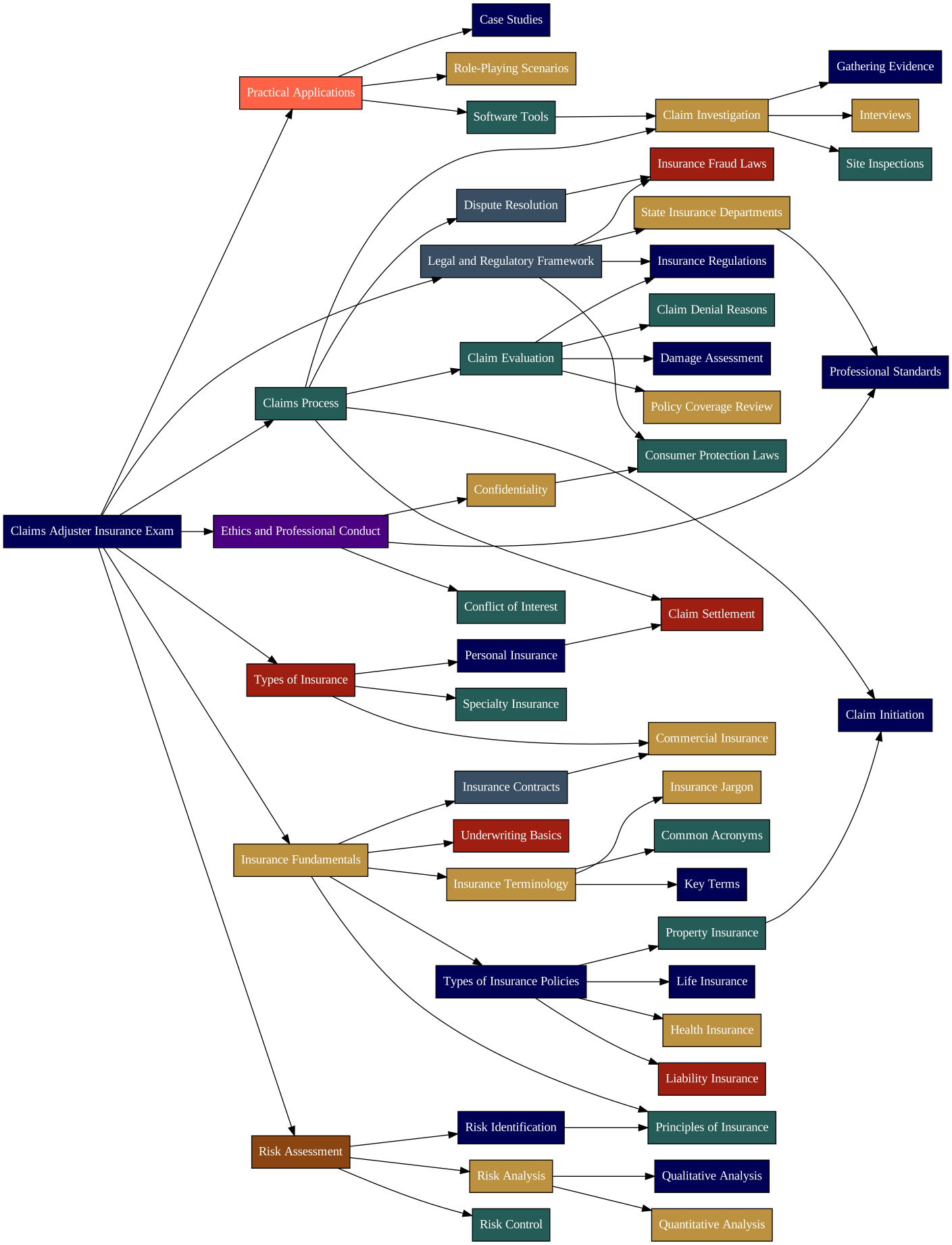
Here are 14 in-depth Q&A study notes to help you prepare for the exam.
Explain the concept of exoneration in surety bonds within the context of Alaska Statute Title 21, Insurance, specifically addressing the conditions under which a surety can be released from its obligations.
Exoneration in surety bonds refers to the surety’s right to be relieved of its obligations under the bond. In Alaska, while Title 21 doesn’t explicitly detail exoneration, the principle is implied through contract law and the surety’s right to seek indemnity from the principal. A surety can seek exoneration if the principal is demonstrably capable of fulfilling the underlying obligation, thereby minimizing the surety’s risk. This might involve a court order compelling the principal to perform or providing sufficient collateral to cover potential losses. The surety must demonstrate a reasonable apprehension of loss to justify exoneration. Furthermore, the surety’s right to exoneration is subject to the terms of the bond agreement and any applicable statutes governing the specific type of bond. Failure to properly pursue exoneration may leave the surety liable for the principal’s default. The surety must also consider the impact of AS 21.36, which addresses insurer responsibilities and liabilities.
Discuss the implications of Alaska Statute 09.38, the Uniform Enforcement of Foreign Judgments Act, on surety bonds issued in Alaska where a claim arises from a judgment obtained in another jurisdiction.
Alaska Statute 09.38, adopting the Uniform Enforcement of Foreign Judgments Act, significantly impacts surety bonds. If a judgment is obtained against a principal in another state and the surety bond covers the principal’s obligations in Alaska, the judgment creditor can seek to enforce that judgment in Alaska. The surety, as a party potentially liable under the bond, becomes subject to the enforcement proceedings. The surety can raise defenses available under Alaska law, such as challenging the validity of the foreign judgment based on lack of jurisdiction or due process violations. However, the surety cannot relitigate the merits of the underlying claim. The surety must act promptly to protect its interests, as the foreign judgment, once domesticated in Alaska, has the same effect as a judgment rendered by an Alaska court. This includes potential liens on the surety’s assets and other enforcement remedies. The surety’s liability is capped by the bond’s penal sum.
Analyze the impact of Alaska Statute Title 45, Chapter 45.500 (Alaska Uniform Commercial Code – Investment Securities) on surety bonds related to lost, destroyed, or stolen securities. Specifically, how does this statute affect the requirements and procedures for obtaining a replacement security bond?
Alaska Statute Title 45, Chapter 45.500, governing investment securities, directly influences surety bonds for lost, destroyed, or stolen securities. When a security certificate is lost, destroyed, or wrongfully taken, the owner can request a replacement. However, the issuer may require a sufficient indemnity bond to protect against potential claims if the original certificate reappears. The statute dictates the conditions under which the issuer must issue a new security, including the provision of a bond. The bond’s amount and terms must be reasonable, considering the security’s value and the risk of double liability. The surety must carefully assess the risk, considering the possibility of the original security being presented for payment or transfer. The statute provides a framework for balancing the owner’s right to a replacement security with the issuer’s need for protection, making the surety’s role crucial in facilitating the process.
Explain the legal recourse available to a beneficiary under a surety bond in Alaska if the surety wrongfully denies a valid claim. Reference relevant Alaska statutes and case law to support your answer.
If a surety wrongfully denies a valid claim in Alaska, the beneficiary has several legal recourses. First, the beneficiary can file a lawsuit against the surety for breach of contract, seeking to recover the amount of the claim up to the bond’s penal sum. Alaska Statute Title 09 governs civil procedure, outlining the process for filing and pursuing such a claim. Additionally, the beneficiary may be able to recover consequential damages if the surety’s denial caused further losses. Alaska law implies a covenant of good faith and fair dealing in every contract, including surety bonds. A wrongful denial could constitute a breach of this covenant, potentially leading to additional damages. The beneficiary may also be able to recover attorney’s fees and costs, depending on the terms of the bond and applicable Alaska statutes. Case law in Alaska supports the principle that sureties have a duty to investigate claims reasonably and in good faith.
Describe the process and legal requirements for a surety to cancel a bond in Alaska, considering the potential impact on the obligee and principal. What specific notice requirements must be met, and what are the potential liabilities if these requirements are not followed?
The process for a surety to cancel a bond in Alaska is governed by the terms of the bond agreement and applicable Alaska statutes. Generally, the surety must provide written notice of cancellation to both the obligee and the principal. The notice period is typically specified in the bond, but if not, a reasonable notice period is required. The cancellation’s impact on the obligee and principal can be significant, potentially requiring the principal to obtain a replacement bond to maintain compliance with underlying obligations. If the surety fails to provide proper notice, it may be liable for damages resulting from the cancellation, such as losses incurred by the obligee due to the principal’s failure to perform. The surety must also ensure that the cancellation complies with any specific statutory requirements for the type of bond involved. Failure to adhere to these requirements could render the cancellation ineffective, leaving the surety liable for future claims.
Explain the concept of “penal sum” in an Alaska surety bond and how it limits the surety’s liability. What factors determine the appropriate penal sum for a specific type of bond, and what are the potential consequences if the penal sum is insufficient to cover a valid claim?
The “penal sum” in an Alaska surety bond represents the maximum amount the surety is liable to pay in the event of a breach of the underlying obligation by the principal. It acts as a ceiling on the surety’s liability, regardless of the actual damages incurred by the obligee. The appropriate penal sum is determined by various factors, including the nature of the underlying obligation, the potential harm to the obligee if the principal defaults, and any statutory requirements. For example, Alaska Statute 08.18.071 dictates the bond amount for construction contractors. If the penal sum is insufficient to cover a valid claim, the obligee will only be able to recover up to the penal sum amount, even if their actual losses exceed that amount. The obligee bears the risk of under-bonding, highlighting the importance of carefully assessing the potential damages when determining the appropriate penal sum.
Discuss the role of reinsurance in the context of Alaska surety bonds. How does reinsurance affect the surety’s risk exposure and financial stability, and what regulatory oversight exists regarding reinsurance agreements for surety companies operating in Alaska, referencing Alaska Statute Title 21?
Reinsurance plays a crucial role in managing risk for surety companies operating in Alaska. It allows a surety company to transfer a portion of its risk to another insurer (the reinsurer), thereby reducing its exposure on large or complex bonds. This enhances the surety’s financial stability and capacity to underwrite more bonds. Alaska Statute Title 21, specifically AS 21.21, addresses reinsurance. It sets forth requirements for reinsurance agreements, including the need for the reinsurer to be financially sound and the agreement to adequately protect the ceding insurer (the surety). The Alaska Division of Insurance oversees reinsurance agreements to ensure compliance with these regulations. Reinsurance can be structured in various ways, such as quota share (where the reinsurer shares a percentage of every risk) or excess of loss (where the reinsurer covers losses exceeding a certain threshold). Proper reinsurance management is essential for surety companies to maintain solvency and meet their obligations under surety bonds.
Explain the legal ramifications for a surety company if they fail to adequately investigate a bond claim in Alaska, referencing specific sections of the Alaska Statutes and relevant case law.
Failure to adequately investigate a bond claim in Alaska can expose a surety company to various legal ramifications. Alaska Statute 21.36.125 outlines unfair claim settlement practices, which include failing to promptly investigate claims, misrepresenting pertinent facts or policy provisions, and failing to acknowledge and act reasonably promptly upon communications with respect to claims. A surety company violating these provisions may face administrative penalties imposed by the Division of Insurance, including fines and suspension or revocation of their certificate of authority. Furthermore, the surety could be subject to a bad faith claim by the obligee if the failure to investigate was unreasonable and caused damages. Alaska case law, such as Guin v. Ha, 591 P.2d 1281 (Alaska 1979), establishes the implied covenant of good faith and fair dealing in every contract, including surety bonds. A breach of this covenant due to inadequate investigation can result in compensatory and, in egregious cases, punitive damages. The surety must demonstrate a reasonable basis for denying or delaying payment, supported by a thorough and impartial investigation.
Discuss the specific requirements for filing a claim against a contractor’s license bond in Alaska, including the time limitations and necessary documentation, as outlined in Alaska Statute 08.18.071.
Alaska Statute 08.18.071 governs claims against contractor’s license bonds. To file a valid claim, the claimant must demonstrate a direct financial loss resulting from the contractor’s violation of AS 08.18 or regulations adopted under it. This typically involves defective workmanship, failure to pay subcontractors or suppliers, or abandonment of the project. The statute imposes a time limitation for filing claims, generally within two years from the date the cause of action accrues, which is often the date of the contractor’s breach or the discovery of the defect. Necessary documentation includes the contract between the claimant and the contractor, evidence of the contractor’s breach (e.g., photos, expert reports), proof of damages (e.g., invoices, repair estimates), and a written demand for payment to the contractor. Claimants must also provide notice to the surety company within a reasonable time after discovering the loss. Failure to comply with these requirements, particularly the time limitation, can result in the claim being denied. The Alaska Department of Commerce, Community, and Economic Development provides further guidance on the claim process.
Explain the concept of “penal sum” in a surety bond and how it relates to the surety’s liability in Alaska. Provide an example scenario.
The “penal sum” of a surety bond represents the maximum amount the surety company is liable to pay in the event of a valid claim. It is not necessarily the amount the obligee will receive, but rather the upper limit of the surety’s financial responsibility. The surety’s liability is capped at the penal sum, regardless of the total damages incurred by the obligee. However, the surety is only liable for the actual damages sustained, up to the penal sum. For example, if a contractor’s license bond has a penal sum of $20,000 and the contractor breaches the contract causing $30,000 in damages, the surety’s liability is limited to $20,000. If the damages are only $10,000, the surety is only liable for $10,000. The penal sum is determined by the statute or regulation requiring the bond and reflects the potential risk associated with the bonded obligation. Alaska Statute 08.18.071(b) specifies the penal sum for contractor’s bonds, which varies based on the type of contractor license.
Describe the process a surety company must follow to exonerate a bond in Alaska, including the required notices and potential liabilities if the process is not followed correctly.
Exoneration of a surety bond in Alaska involves the surety company being released from its obligations under the bond. The process typically begins with the principal (the party bonded) fulfilling the underlying obligation or the expiration of the bond term. The surety must provide written notice to the obligee (the party protected by the bond) of its intent to exonerate the bond. This notice should specify the date of exoneration and the reasons for it. If the obligee objects to the exoneration, they must provide written notice to the surety within a specified timeframe, typically outlined in the bond agreement or applicable statutes. If the obligee fails to object, the surety is generally exonerated from further liability. However, if the surety fails to provide proper notice or prematurely exonerates the bond, it may remain liable for claims arising from events that occurred prior to the purported exoneration. Furthermore, the surety may be subject to penalties or legal action for breach of contract. Alaska Statute 21.36.125 regarding unfair claim settlement practices could be invoked if the exoneration is handled improperly.
What are the specific grounds for denying a claim against a surety bond in Alaska, and what documentation is required to support the denial? Refer to relevant Alaska statutes and case law.
A surety company can deny a claim against a surety bond in Alaska based on several grounds. These include: lack of a valid bond, the claim falling outside the scope of the bond’s coverage, the claimant failing to comply with the bond’s claim filing requirements (e.g., time limitations, notice provisions), the principal not being in default, or the damages claimed being unsubstantiated or excessive. To support a denial, the surety must conduct a thorough investigation and gather relevant documentation. This may include the bond agreement, the underlying contract between the principal and the claimant, evidence of the principal’s performance, expert reports, and legal opinions. The surety must also provide the claimant with a written explanation of the reasons for the denial, citing the specific provisions of the bond or applicable law that support the decision. Alaska Statute 21.36.125 prohibits unfair claim settlement practices, requiring the surety to act in good faith and provide a reasonable basis for the denial. Case law, such as State for Use and Benefit of Palmer Supply Co. v. Walsh & Co., 575 P.2d 1213 (Alaska 1978), emphasizes the surety’s duty to investigate claims and act fairly.
Discuss the differences between a surety bond and insurance policy in the context of Alaska law, focusing on the roles of the parties involved and the risk transfer mechanism.
While both surety bonds and insurance policies provide financial protection, they operate under fundamentally different principles. In a surety bond, there are three parties: the principal (the party required to obtain the bond), the obligee (the party protected by the bond), and the surety (the guarantor). The surety bond guarantees the principal’s performance of an obligation to the obligee. If the principal defaults, the surety will compensate the obligee for the loss, but the surety has the right to seek reimbursement from the principal. In contrast, an insurance policy involves two parties: the insured and the insurer. The insurance policy transfers risk from the insured to the insurer, who agrees to pay for covered losses in exchange for a premium. The insurer does not have a right of recourse against the insured for covered losses. Under Alaska law, surety bonds are regulated under Title 21 of the Alaska Statutes, which governs insurance. However, the specific provisions applicable to surety bonds may differ from those applicable to traditional insurance policies due to the unique nature of the surety relationship. The risk transfer mechanism in a surety bond is more akin to a guarantee than a transfer of risk.
Explain the concept of “subrogation” in the context of surety bonds in Alaska, and how it affects the surety’s rights and remedies after paying a claim. Cite relevant Alaska case law if available.
Subrogation is a legal doctrine that allows a surety company, after paying a claim to the obligee, to step into the shoes of the obligee and assert any rights and remedies the obligee had against the principal or other parties responsible for the loss. This right is inherent in the surety relationship and is designed to allow the surety to recover its losses. In Alaska, the right of subrogation is generally recognized and enforced. After paying a claim, the surety can pursue legal action against the principal to recover the amount paid, plus any expenses incurred in investigating and settling the claim. The surety can also assert any liens or other security interests the obligee had against the principal’s assets. The surety’s right of subrogation is subject to certain limitations. For example, the surety cannot assert rights that are superior to those of the obligee. Also, the surety’s right of subrogation may be affected by the terms of the bond agreement or applicable statutes. While specific Alaska case law directly addressing subrogation in the context of surety bonds may be limited, the general principles of subrogation are well-established and apply to surety relationships. The surety must act diligently to preserve its subrogation rights and avoid any actions that could prejudice its ability to recover its losses.