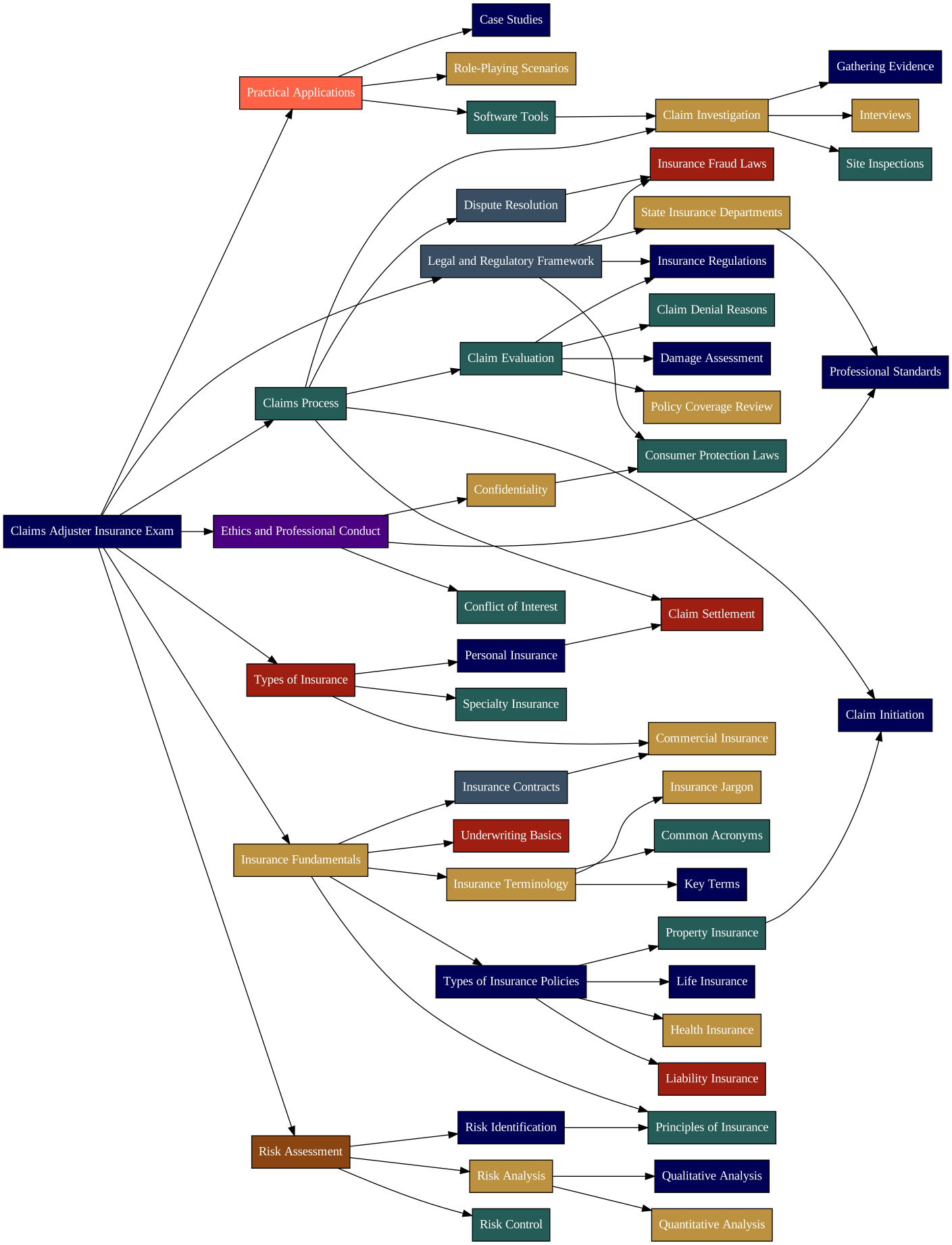
Quiz-summary
0 of 30 questions completed
Questions:
- 1
- 2
- 3
- 4
- 5
- 6
- 7
- 8
- 9
- 10
- 11
- 12
- 13
- 14
- 15
- 16
- 17
- 18
- 19
- 20
- 21
- 22
- 23
- 24
- 25
- 26
- 27
- 28
- 29
- 30
Information
Premium Practice Questions
You have already completed the quiz before. Hence you can not start it again.
Quiz is loading...
You must sign in or sign up to start the quiz.
You have to finish following quiz, to start this quiz:
Results
0 of 30 questions answered correctly
Your time:
Time has elapsed
You have reached 0 of 0 points, (0)
Categories
- Not categorized 0%
- 1
- 2
- 3
- 4
- 5
- 6
- 7
- 8
- 9
- 10
- 11
- 12
- 13
- 14
- 15
- 16
- 17
- 18
- 19
- 20
- 21
- 22
- 23
- 24
- 25
- 26
- 27
- 28
- 29
- 30
- Answered
- Review
-
Question 1 of 30
1. Question
Alejandro purchased a property in Miami, Florida, and secured an owner’s title insurance policy from Sunshine Title Insurance. Six months later, he received a notice from a distant relative of the previous owner, claiming an inherited interest in the property that was not disclosed during the title search. Alejandro immediately notified Sunshine Title Insurance of the potential claim. Sunshine Title Insurance conducted an investigation and determined that the relative’s claim had merit, representing a valid title defect covered under Alejandro’s policy. However, Alejandro, frustrated with the situation, refused to allow Sunshine Title Insurance to negotiate with the relative to clear the title, insisting instead on pursuing his own legal action against the relative without consulting the insurer. Furthermore, he incurred significant legal fees in this endeavor. What is the most likely outcome regarding Sunshine Title Insurance’s responsibility for covering Alejandro’s legal fees and the resolution of the title defect?
Correct
In Florida, a title insurance claim arises when a defect in title, covered by the policy, causes a loss to the insured. The initial step involves the insured providing formal notification to the title insurer, detailing the nature of the claim and the specific loss incurred. The insurer then undertakes a comprehensive investigation, examining relevant public records, conducting interviews, and potentially seeking legal counsel to assess the validity and extent of the claim. This investigation aims to determine if the alleged defect is indeed covered under the policy’s terms and conditions, considering any exclusions or limitations. If the claim is deemed valid and covered, the insurer proceeds to resolve it. Resolution methods vary depending on the nature of the defect and the policy provisions. Common approaches include clearing the title defect through legal action (e.g., a quiet title suit), negotiating settlements with adverse claimants, or compensating the insured for the financial loss sustained due to the defect. The insurer’s goal is to restore the insured’s title to its insured status or provide appropriate financial compensation. However, the insurer is not obligated to pay out more than the policy limits, and the insured has a duty to mitigate damages. If the insured fails to cooperate with the insurer’s investigation or resolution efforts, it could jeopardize the claim. The entire process is governed by Florida’s title insurance laws and regulations, aiming to protect both the insured and the insurer’s interests.
Incorrect
In Florida, a title insurance claim arises when a defect in title, covered by the policy, causes a loss to the insured. The initial step involves the insured providing formal notification to the title insurer, detailing the nature of the claim and the specific loss incurred. The insurer then undertakes a comprehensive investigation, examining relevant public records, conducting interviews, and potentially seeking legal counsel to assess the validity and extent of the claim. This investigation aims to determine if the alleged defect is indeed covered under the policy’s terms and conditions, considering any exclusions or limitations. If the claim is deemed valid and covered, the insurer proceeds to resolve it. Resolution methods vary depending on the nature of the defect and the policy provisions. Common approaches include clearing the title defect through legal action (e.g., a quiet title suit), negotiating settlements with adverse claimants, or compensating the insured for the financial loss sustained due to the defect. The insurer’s goal is to restore the insured’s title to its insured status or provide appropriate financial compensation. However, the insurer is not obligated to pay out more than the policy limits, and the insured has a duty to mitigate damages. If the insured fails to cooperate with the insurer’s investigation or resolution efforts, it could jeopardize the claim. The entire process is governed by Florida’s title insurance laws and regulations, aiming to protect both the insured and the insurer’s interests.
-
Question 2 of 30
2. Question
Anya purchases a property in Florida and obtains a standard owner’s title insurance policy. Six months later, she discovers an undisclosed pre-existing lien on the property that was not revealed during the initial title search. This lien significantly impairs her ability to sell the property. The title insurance policy does not explicitly exclude this type of lien. Assuming Anya had no prior knowledge of the lien and did not contribute to its creation, what is the most likely outcome regarding her title insurance claim? Consider Florida-specific title insurance regulations and standard policy provisions.
Correct
In Florida, title insurance claims arising from defects not explicitly excluded from the policy are generally covered. However, the extent of coverage depends on several factors, including the type of policy (owner’s or lender’s), the specific policy provisions, and whether the defect was known to the insured but not disclosed to the insurer. A standard owner’s policy protects against defects discoverable through public records, while an enhanced policy offers broader coverage. If the title defect existed at the time the policy was issued, was not listed as an exception, and was not created, suffered, assumed, or agreed to by the insured, it is likely covered. If Anya purchased a standard owner’s policy, the undisclosed pre-existing lien, if discoverable through a title search, would typically be covered, up to the policy limits and subject to any applicable deductibles. The title insurance company would be responsible for clearing the lien or compensating Anya for the loss of value, depending on the circumstances and the policy terms. However, if Anya knew about the lien before purchasing the property and did not disclose it, the claim might be denied due to her own actions. The key is whether the lien was a matter of public record and whether Anya had any prior knowledge of it.
Incorrect
In Florida, title insurance claims arising from defects not explicitly excluded from the policy are generally covered. However, the extent of coverage depends on several factors, including the type of policy (owner’s or lender’s), the specific policy provisions, and whether the defect was known to the insured but not disclosed to the insurer. A standard owner’s policy protects against defects discoverable through public records, while an enhanced policy offers broader coverage. If the title defect existed at the time the policy was issued, was not listed as an exception, and was not created, suffered, assumed, or agreed to by the insured, it is likely covered. If Anya purchased a standard owner’s policy, the undisclosed pre-existing lien, if discoverable through a title search, would typically be covered, up to the policy limits and subject to any applicable deductibles. The title insurance company would be responsible for clearing the lien or compensating Anya for the loss of value, depending on the circumstances and the policy terms. However, if Anya knew about the lien before purchasing the property and did not disclose it, the claim might be denied due to her own actions. The key is whether the lien was a matter of public record and whether Anya had any prior knowledge of it.
-
Question 3 of 30
3. Question
A buyer, Leticia, is purchasing a property in Miami-Dade County, Florida, for \$675,000. As a TIPIC, you are preparing the closing documents. The title insurance rate in Florida is \$5.75 per \$1,000 of property value. Additionally, there is a municipal surcharge of 0.2% applied to the base title insurance premium. Leticia wants to understand the total premium she will pay for her title insurance policy, including the surcharge. Accurately calculate the base title insurance premium, apply the municipal surcharge, and determine the total premium Leticia will pay. What is the total premium for the title insurance policy, including the municipal surcharge, rounded to the nearest cent? This requires precise calculation and understanding of Florida’s title insurance premium structure.
Correct
To calculate the total premium including the municipal surcharge, we first need to determine the base premium for the title insurance policy. The formula for the base premium is: Base Premium = (Property Value / \$1,000) * Rate per \$1,000 In this case, the property value is \$675,000 and the rate is \$5.75 per \$1,000. Therefore: Base Premium = (675000 / 1000) * 5.75 Base Premium = 675 * 5.75 Base Premium = \$3,881.25 Next, we calculate the municipal surcharge, which is 0.2% of the base premium: Municipal Surcharge = Base Premium * 0.002 Municipal Surcharge = 3881.25 * 0.002 Municipal Surcharge = \$7.7625 Rounding the municipal surcharge to the nearest cent, we get \$7.76. Finally, we add the base premium and the municipal surcharge to find the total premium: Total Premium = Base Premium + Municipal Surcharge Total Premium = 3881.25 + 7.76 Total Premium = \$3,889.01 Therefore, the total premium for the title insurance policy, including the municipal surcharge, is \$3,889.01. This calculation ensures that the client is accurately charged for all applicable fees and surcharges as mandated by Florida title insurance regulations. The proper calculation and disclosure of these fees are crucial for maintaining compliance and transparency in real estate transactions.
Incorrect
To calculate the total premium including the municipal surcharge, we first need to determine the base premium for the title insurance policy. The formula for the base premium is: Base Premium = (Property Value / \$1,000) * Rate per \$1,000 In this case, the property value is \$675,000 and the rate is \$5.75 per \$1,000. Therefore: Base Premium = (675000 / 1000) * 5.75 Base Premium = 675 * 5.75 Base Premium = \$3,881.25 Next, we calculate the municipal surcharge, which is 0.2% of the base premium: Municipal Surcharge = Base Premium * 0.002 Municipal Surcharge = 3881.25 * 0.002 Municipal Surcharge = \$7.7625 Rounding the municipal surcharge to the nearest cent, we get \$7.76. Finally, we add the base premium and the municipal surcharge to find the total premium: Total Premium = Base Premium + Municipal Surcharge Total Premium = 3881.25 + 7.76 Total Premium = \$3,889.01 Therefore, the total premium for the title insurance policy, including the municipal surcharge, is \$3,889.01. This calculation ensures that the client is accurately charged for all applicable fees and surcharges as mandated by Florida title insurance regulations. The proper calculation and disclosure of these fees are crucial for maintaining compliance and transparency in real estate transactions.
-
Question 4 of 30
4. Question
Aaliyah purchased an owner’s title insurance policy in Florida when she bought her beachfront condo. Six months later, facing unexpected financial difficulties, she took out a second mortgage on the property without informing the title insurance company. Subsequently, Aaliyah defaulted on the second mortgage, and the lender initiated foreclosure proceedings. Aaliyah then filed a claim with her title insurance company, arguing that the foreclosure action clouded her title. Considering the principles of title insurance coverage in Florida, and assuming Aaliyah did not disclose her intent to take out a second mortgage at the time she purchased the original title insurance policy, what is the most likely outcome of Aaliyah’s claim?
Correct
In Florida, a title insurance policy protects against defects in title, undisclosed liens, and other encumbrances that existed *before* the policy’s effective date, but were not discovered during the title search. The standard owner’s policy generally covers matters of record, such as recorded mortgages, judgments, and easements. However, it typically excludes matters that are created *after* the policy date, government regulations (unless a notice of violation or enforcement is recorded), and known defects that the insured was aware of but failed to disclose to the insurer. Crucially, standard policies also exclude issues arising from the insured’s own actions that create a defect. Therefore, if Aaliyah knowingly and intentionally encumbered her property *after* obtaining the owner’s policy, the title insurance company would likely deny a claim arising from that encumbrance. This is because the policy insures the title as it existed on the effective date, not against subsequent actions by the insured. The key is whether the encumbrance was created by Aaliyah’s deliberate actions after the policy was issued.
Incorrect
In Florida, a title insurance policy protects against defects in title, undisclosed liens, and other encumbrances that existed *before* the policy’s effective date, but were not discovered during the title search. The standard owner’s policy generally covers matters of record, such as recorded mortgages, judgments, and easements. However, it typically excludes matters that are created *after* the policy date, government regulations (unless a notice of violation or enforcement is recorded), and known defects that the insured was aware of but failed to disclose to the insurer. Crucially, standard policies also exclude issues arising from the insured’s own actions that create a defect. Therefore, if Aaliyah knowingly and intentionally encumbered her property *after* obtaining the owner’s policy, the title insurance company would likely deny a claim arising from that encumbrance. This is because the policy insures the title as it existed on the effective date, not against subsequent actions by the insured. The key is whether the encumbrance was created by Aaliyah’s deliberate actions after the policy was issued.
-
Question 5 of 30
5. Question
Ricardo purchases a home in Miami, Florida, securing a mortgage from Sunshine State Bank. He obtains both an owner’s title insurance policy and a lender’s title insurance policy. Several years later, after Ricardo has significantly paid down his mortgage, a previously unknown mechanic’s lien surfaces, dating back to work done by a contractor before Ricardo purchased the property. This lien threatens Ricardo’s ownership. Considering the nature and purpose of owner’s and lender’s title insurance policies in Florida, which policy or policies would primarily protect Ricardo against financial loss or legal expenses associated with this mechanic’s lien, and to what extent would each policy provide coverage given the circumstances?
Correct
In Florida, title insurance policies are contracts that protect against financial loss due to title defects, liens, or other encumbrances that existed at the time the policy was issued but were not discovered during the title search. A standard owner’s policy protects the homeowner for as long as they or their heirs own the property. The coverage extends to defects that were not excluded or excepted from coverage in the policy. An extended coverage policy provides more protection than a standard policy. It covers defects that could be discovered by inspecting the property, unrecorded liens, and other matters not typically found in public records. The lender’s policy protects the lender’s interest in the property. It decreases as the loan is paid off. It does not protect the owner directly. If a claim arises, the title insurer will either pay the insured for the loss or take legal action to clear the title. The title insurance company’s obligation is limited to the amount of the policy and the cost of defending the title. It is important to understand the specific terms, conditions, and exclusions of the title insurance policy to fully understand the coverage provided.
Incorrect
In Florida, title insurance policies are contracts that protect against financial loss due to title defects, liens, or other encumbrances that existed at the time the policy was issued but were not discovered during the title search. A standard owner’s policy protects the homeowner for as long as they or their heirs own the property. The coverage extends to defects that were not excluded or excepted from coverage in the policy. An extended coverage policy provides more protection than a standard policy. It covers defects that could be discovered by inspecting the property, unrecorded liens, and other matters not typically found in public records. The lender’s policy protects the lender’s interest in the property. It decreases as the loan is paid off. It does not protect the owner directly. If a claim arises, the title insurer will either pay the insured for the loss or take legal action to clear the title. The title insurance company’s obligation is limited to the amount of the policy and the cost of defending the title. It is important to understand the specific terms, conditions, and exclusions of the title insurance policy to fully understand the coverage provided.
-
Question 6 of 30
6. Question
Aurora is a title insurance producer in Florida handling a complex transaction involving a commercial property valued at \( \$675,000 \). The property is located near a former industrial site, raising environmental concerns that necessitate an additional risk assessment. The standard title insurance policy in Florida has a base premium rate of \( \$5.00 \) per \( \$1,000 \) of property value. Due to the environmental risks identified, an additional premium of \( \$1.25 \) per \( \$1,000 \) is applied. Florida statutes mandate an \( 8\% \) discount on the total premium for properties meeting certain energy efficiency standards, which this property meets. Considering these factors, what is the total premium due for the title insurance policy for this property?
Correct
To calculate the total premium due, we need to calculate the base premium, the additional risk premium, and then apply the statutory discount. 1. **Base Premium Calculation:** The base premium is calculated as \( \$5.00 \) per \( \$1,000 \) of the property value. So, for a \( \$675,000 \) property, the base premium is: \[ \text{Base Premium} = \frac{\$675,000}{\$1,000} \times \$5.00 = \$3,375 \] 2. **Additional Risk Premium Calculation:** The additional risk premium is \( \$1.25 \) per \( \$1,000 \) of the property value due to the environmental concerns. So, for a \( \$675,000 \) property, the additional risk premium is: \[ \text{Additional Risk Premium} = \frac{\$675,000}{\$1,000} \times \$1.25 = \$843.75 \] 3. **Total Premium Before Discount:** The total premium before applying any discount is the sum of the base premium and the additional risk premium: \[ \text{Total Premium Before Discount} = \$3,375 + \$843.75 = \$4,218.75 \] 4. **Statutory Discount Calculation:** The statutory discount is \( 8\% \) of the total premium before the discount: \[ \text{Statutory Discount} = 0.08 \times \$4,218.75 = \$337.50 \] 5. **Total Premium Due:** Finally, subtract the statutory discount from the total premium before the discount to find the total premium due: \[ \text{Total Premium Due} = \$4,218.75 – \$337.50 = \$3,881.25 \] Therefore, the total premium due for the title insurance policy, considering the base premium, additional risk premium, and statutory discount, is \( \$3,881.25 \). This calculation ensures compliance with Florida’s title insurance regulations and reflects the specific risk factors associated with the property.
Incorrect
To calculate the total premium due, we need to calculate the base premium, the additional risk premium, and then apply the statutory discount. 1. **Base Premium Calculation:** The base premium is calculated as \( \$5.00 \) per \( \$1,000 \) of the property value. So, for a \( \$675,000 \) property, the base premium is: \[ \text{Base Premium} = \frac{\$675,000}{\$1,000} \times \$5.00 = \$3,375 \] 2. **Additional Risk Premium Calculation:** The additional risk premium is \( \$1.25 \) per \( \$1,000 \) of the property value due to the environmental concerns. So, for a \( \$675,000 \) property, the additional risk premium is: \[ \text{Additional Risk Premium} = \frac{\$675,000}{\$1,000} \times \$1.25 = \$843.75 \] 3. **Total Premium Before Discount:** The total premium before applying any discount is the sum of the base premium and the additional risk premium: \[ \text{Total Premium Before Discount} = \$3,375 + \$843.75 = \$4,218.75 \] 4. **Statutory Discount Calculation:** The statutory discount is \( 8\% \) of the total premium before the discount: \[ \text{Statutory Discount} = 0.08 \times \$4,218.75 = \$337.50 \] 5. **Total Premium Due:** Finally, subtract the statutory discount from the total premium before the discount to find the total premium due: \[ \text{Total Premium Due} = \$4,218.75 – \$337.50 = \$3,881.25 \] Therefore, the total premium due for the title insurance policy, considering the base premium, additional risk premium, and statutory discount, is \( \$3,881.25 \). This calculation ensures compliance with Florida’s title insurance regulations and reflects the specific risk factors associated with the property.
-
Question 7 of 30
7. Question
Alejandro, a newly licensed Florida TIPIC, is eager to build relationships with local real estate agents to grow his business. He is considering several strategies and wants to ensure he complies with the Real Estate Settlement Procedures Act (RESPA). Which of the following actions would MOST likely be considered a violation of RESPA Section 8, specifically concerning kickbacks and unearned fees, if implemented by Alejandro in his efforts to gain referrals from real estate agents in the Tampa area? Assume all actions are not disclosed.
Correct
In Florida, the Real Estate Settlement Procedures Act (RESPA) aims to protect consumers from abusive practices during the real estate settlement process. A key component of RESPA is Section 8, which prohibits kickbacks, fee-splitting, and unearned fees. This means that title insurance producers cannot offer or receive anything of value in exchange for referrals of settlement service business. A “thing of value” is broadly interpreted and includes not only cash but also discounts, services, or other items that could be seen as influencing a referral. While providing educational materials about title insurance to real estate agents is generally permissible as a means of informing and educating them, doing so in exchange for, or with the expectation of, receiving referrals would violate RESPA. Similarly, sponsoring a lunch-and-learn for real estate agents where the primary purpose is to solicit referrals under the guise of education is also a violation. Simply providing a generic promotional item, like a pen, is usually permissible, but providing high-value items or services tied to referrals is not. The crucial element is whether the action is intended as an inducement for referrals. Offering a discount on title insurance premiums to a real estate agent’s clients, while seemingly beneficial to the client, could be construed as an indirect benefit to the agent for steering business, and therefore, a violation of RESPA if it is tied to a referral agreement.
Incorrect
In Florida, the Real Estate Settlement Procedures Act (RESPA) aims to protect consumers from abusive practices during the real estate settlement process. A key component of RESPA is Section 8, which prohibits kickbacks, fee-splitting, and unearned fees. This means that title insurance producers cannot offer or receive anything of value in exchange for referrals of settlement service business. A “thing of value” is broadly interpreted and includes not only cash but also discounts, services, or other items that could be seen as influencing a referral. While providing educational materials about title insurance to real estate agents is generally permissible as a means of informing and educating them, doing so in exchange for, or with the expectation of, receiving referrals would violate RESPA. Similarly, sponsoring a lunch-and-learn for real estate agents where the primary purpose is to solicit referrals under the guise of education is also a violation. Simply providing a generic promotional item, like a pen, is usually permissible, but providing high-value items or services tied to referrals is not. The crucial element is whether the action is intended as an inducement for referrals. Offering a discount on title insurance premiums to a real estate agent’s clients, while seemingly beneficial to the client, could be construed as an indirect benefit to the agent for steering business, and therefore, a violation of RESPA if it is tied to a referral agreement.
-
Question 8 of 30
8. Question
Amelia, a prospective homebuyer in Miami-Dade County, Florida, discovers through a preliminary title search that the property she intends to purchase has a potential cloud on the title due to a decades-old boundary dispute with a neighboring property owner. The dispute, while seemingly minor, has never been formally resolved, and the neighbor continues to assert a claim to a small portion of Amelia’s intended property. The title insurance company is hesitant to issue a standard owner’s policy without resolving this issue. Understanding her options, Amelia consults with a real estate attorney. Given the situation and the need for clear, insurable title, what legal action would the attorney most likely advise Amelia’s seller to pursue to resolve the title defect before the property can be transferred and insured in Florida?
Correct
In Florida, a quiet title action is a legal proceeding initiated to establish clear ownership of real property by resolving any conflicting claims or “clouds” on the title. This action is governed by Florida Statutes, specifically Chapter 65, which outlines the procedures and requirements for such cases. The purpose is to remove any doubts or uncertainties regarding the ownership of the property, making it marketable and insurable. A successful quiet title action results in a court order that legally establishes the rightful owner and eliminates adverse claims. This is crucial when issues like boundary disputes, conflicting deeds, or unresolved liens cloud the title. The process typically involves a thorough title search, identifying all potential claimants, and providing them with legal notice to appear in court and assert their claims. If a claimant fails to appear or the court finds in favor of the plaintiff, a final judgment is entered, effectively quieting the title and establishing clear ownership. Title insurance companies often require a quiet title action to resolve significant title defects before issuing a policy.
Incorrect
In Florida, a quiet title action is a legal proceeding initiated to establish clear ownership of real property by resolving any conflicting claims or “clouds” on the title. This action is governed by Florida Statutes, specifically Chapter 65, which outlines the procedures and requirements for such cases. The purpose is to remove any doubts or uncertainties regarding the ownership of the property, making it marketable and insurable. A successful quiet title action results in a court order that legally establishes the rightful owner and eliminates adverse claims. This is crucial when issues like boundary disputes, conflicting deeds, or unresolved liens cloud the title. The process typically involves a thorough title search, identifying all potential claimants, and providing them with legal notice to appear in court and assert their claims. If a claimant fails to appear or the court finds in favor of the plaintiff, a final judgment is entered, effectively quieting the title and establishing clear ownership. Title insurance companies often require a quiet title action to resolve significant title defects before issuing a policy.
-
Question 9 of 30
9. Question
A developer, Alistair Humphrey, is securing title insurance for a new condominium project in Miami, Florida. The initial title insurance policy is for \$250,000. Due to increased project costs and potential liabilities, Alistair decides to increase the coverage to \$350,000. The title insurance company charges \$5.75 per \$1,000 for the initial \$250,000 coverage and \$5.00 per \$1,000 for any additional coverage above \$250,000. Considering these tiered rates, what is the total premium Alistair will pay for the \$350,000 title insurance policy? This calculation is essential for Alistair to accurately budget the project costs and ensure adequate title insurance coverage for the condominium development in accordance with Florida’s title insurance regulations.
Correct
To calculate the total premium, we need to consider both the base rate for the initial coverage amount and the additional rate for the increased coverage. The initial coverage is $250,000, and the rate is $5.75 per $1,000. The increased coverage is $100,000 ($350,000 – $250,000), and the rate for the additional coverage is $5.00 per $1,000. First, calculate the premium for the initial coverage: \[ \text{Premium for initial coverage} = \frac{250,000}{1,000} \times 5.75 = 250 \times 5.75 = 1437.50 \] Next, calculate the premium for the increased coverage: \[ \text{Premium for increased coverage} = \frac{100,000}{1,000} \times 5.00 = 100 \times 5.00 = 500.00 \] Finally, add the two premiums together to find the total premium: \[ \text{Total premium} = 1437.50 + 500.00 = 1937.50 \] Therefore, the total premium for a $350,000 title insurance policy, given the tiered rate structure, is $1937.50. This calculation demonstrates how title insurance premiums are determined based on the coverage amount and the applicable rates, which can vary based on the amount of coverage. In Florida, understanding these rate structures is crucial for title insurance producers to accurately quote premiums and ensure compliance with state regulations.
Incorrect
To calculate the total premium, we need to consider both the base rate for the initial coverage amount and the additional rate for the increased coverage. The initial coverage is $250,000, and the rate is $5.75 per $1,000. The increased coverage is $100,000 ($350,000 – $250,000), and the rate for the additional coverage is $5.00 per $1,000. First, calculate the premium for the initial coverage: \[ \text{Premium for initial coverage} = \frac{250,000}{1,000} \times 5.75 = 250 \times 5.75 = 1437.50 \] Next, calculate the premium for the increased coverage: \[ \text{Premium for increased coverage} = \frac{100,000}{1,000} \times 5.00 = 100 \times 5.00 = 500.00 \] Finally, add the two premiums together to find the total premium: \[ \text{Total premium} = 1437.50 + 500.00 = 1937.50 \] Therefore, the total premium for a $350,000 title insurance policy, given the tiered rate structure, is $1937.50. This calculation demonstrates how title insurance premiums are determined based on the coverage amount and the applicable rates, which can vary based on the amount of coverage. In Florida, understanding these rate structures is crucial for title insurance producers to accurately quote premiums and ensure compliance with state regulations.
-
Question 10 of 30
10. Question
A title insurance company in Jacksonville, Florida, is considering implementing a new electronic closing platform to streamline its closing processes. The platform would allow for online notarization, electronic signatures, and secure document storage. Considering the impact of technology on the title insurance industry and the potential benefits and risks associated with electronic closing platforms, what are the key cybersecurity considerations that the company must address before implementing the new platform, and what measures should they take to protect sensitive client data?
Correct
In Florida, title insurance companies are increasingly using technology to streamline their operations, improve efficiency, and enhance customer service. Software and tools for title searches can automate the process of examining public records and identifying potential title defects. Electronic closing platforms facilitate online closings and reduce the need for paper documents. Cybersecurity is a major concern for title insurance companies, as they handle sensitive financial and personal information. Innovations in title insurance processes include the use of blockchain technology to create more secure and transparent title records.
Incorrect
In Florida, title insurance companies are increasingly using technology to streamline their operations, improve efficiency, and enhance customer service. Software and tools for title searches can automate the process of examining public records and identifying potential title defects. Electronic closing platforms facilitate online closings and reduce the need for paper documents. Cybersecurity is a major concern for title insurance companies, as they handle sensitive financial and personal information. Innovations in title insurance processes include the use of blockchain technology to create more secure and transparent title records.
-
Question 11 of 30
11. Question
Amelia, a resident of Miami-Dade County, Florida, purchased a property in 2015. She recently discovered an old easement recorded in 1980 that benefits a neighboring property owned by Javier. The easement grants Javier the right to use a portion of Amelia’s land for accessing a public beach. Amelia believes the easement is no longer valid because Javier has consistently used a different, more convenient route for beach access since 2016. Javier insists the easement remains valid and enforceable. Amelia wants to clear her title of this easement to facilitate a future sale of her property. Which legal action would be most appropriate for Amelia to pursue in Florida to resolve this title issue, considering the potential impact on marketability and insurability of her title, and what would be the key element in this action to ensure a conclusive resolution?
Correct
In Florida, a quiet title action is a legal proceeding used to establish clear ownership of real property when there are conflicting claims or uncertainties about the title. It is governed by Florida Statutes, Chapter 65, which outlines the procedures and requirements for such actions. The purpose of a quiet title action is to remove any clouds on the title, such as liens, encumbrances, or adverse claims, and to obtain a court order that definitively establishes the rightful owner. A key element in a quiet title action is providing proper notice to all parties who may have an interest in the property. This includes conducting a thorough title search to identify potential claimants and serving them with the lawsuit. Failure to provide proper notice can render the judgment ineffective against those parties. The court will review the evidence presented by all parties, including deeds, surveys, and other relevant documents, to determine the validity of the claims. If the court finds that the plaintiff has a superior claim to the property, it will issue a judgment quieting title in their favor, which effectively clears the title and establishes marketable ownership. The judgment is then recorded in the public records, providing notice to the world of the court’s determination. This process is crucial for ensuring that real estate transactions can proceed smoothly and that property owners have clear and secure title to their land.
Incorrect
In Florida, a quiet title action is a legal proceeding used to establish clear ownership of real property when there are conflicting claims or uncertainties about the title. It is governed by Florida Statutes, Chapter 65, which outlines the procedures and requirements for such actions. The purpose of a quiet title action is to remove any clouds on the title, such as liens, encumbrances, or adverse claims, and to obtain a court order that definitively establishes the rightful owner. A key element in a quiet title action is providing proper notice to all parties who may have an interest in the property. This includes conducting a thorough title search to identify potential claimants and serving them with the lawsuit. Failure to provide proper notice can render the judgment ineffective against those parties. The court will review the evidence presented by all parties, including deeds, surveys, and other relevant documents, to determine the validity of the claims. If the court finds that the plaintiff has a superior claim to the property, it will issue a judgment quieting title in their favor, which effectively clears the title and establishes marketable ownership. The judgment is then recorded in the public records, providing notice to the world of the court’s determination. This process is crucial for ensuring that real estate transactions can proceed smoothly and that property owners have clear and secure title to their land.
-
Question 12 of 30
12. Question
Catalina works as an independent contractor for “Sunshine Title,” a title insurance agency in Florida. According to her agreement, Sunshine Title receives 15% of the total title insurance premium for each policy sold, with a further split of 60% retained by Sunshine Title and 40% paid to Catalina as her commission. The title insurance underwriter retains the remaining 85% of the total premium. On a recent transaction, a title insurance policy was issued for a property valued at \$450,000. The base rate for the policy is \$250, and the rate per \$1000 of property value is \$2.50. Considering these factors and the commission structure, what is Catalina’s commission from this specific title insurance policy, reflecting the tiered distribution of premiums as per Florida regulations?
Correct
To calculate the premium split, we first determine the total premium for the title insurance policy. The formula for calculating the premium is: \[ \text{Premium} = \text{Base Rate} + (\text{Property Value} \times \text{Rate per } \$1000) \] In this case, the base rate is \$250, and the rate per \$1000 of property value is \$2.50. The property value is \$450,000. \[ \text{Premium} = \$250 + (\$450,000 \times \frac{\$2.50}{\$1000}) \] \[ \text{Premium} = \$250 + (\$450 \times \$2.50) \] \[ \text{Premium} = \$250 + \$1125 \] \[ \text{Premium} = \$1375 \] Now, we calculate the split between the title insurance underwriter and the title agent. The agreement states that the underwriter receives 85% of the premium, and the title agent receives 15%. \[ \text{Underwriter Share} = 0.85 \times \$1375 = \$1168.75 \] \[ \text{Title Agent Share} = 0.15 \times \$1375 = \$206.25 \] Next, we need to calculate the commission split between the title agent and the independent contractor, which is 60% to the title agent and 40% to the independent contractor. \[ \text{Independent Contractor Commission} = 0.40 \times \$206.25 = \$82.50 \] Therefore, the independent contractor’s commission is \$82.50. This calculation reflects the tiered distribution of title insurance premiums, starting from the total premium calculation, splitting it between the underwriter and the agent, and finally, splitting the agent’s share with the independent contractor according to their agreement. This ensures compliance with Florida regulations regarding premium distribution and agent compensation.
Incorrect
To calculate the premium split, we first determine the total premium for the title insurance policy. The formula for calculating the premium is: \[ \text{Premium} = \text{Base Rate} + (\text{Property Value} \times \text{Rate per } \$1000) \] In this case, the base rate is \$250, and the rate per \$1000 of property value is \$2.50. The property value is \$450,000. \[ \text{Premium} = \$250 + (\$450,000 \times \frac{\$2.50}{\$1000}) \] \[ \text{Premium} = \$250 + (\$450 \times \$2.50) \] \[ \text{Premium} = \$250 + \$1125 \] \[ \text{Premium} = \$1375 \] Now, we calculate the split between the title insurance underwriter and the title agent. The agreement states that the underwriter receives 85% of the premium, and the title agent receives 15%. \[ \text{Underwriter Share} = 0.85 \times \$1375 = \$1168.75 \] \[ \text{Title Agent Share} = 0.15 \times \$1375 = \$206.25 \] Next, we need to calculate the commission split between the title agent and the independent contractor, which is 60% to the title agent and 40% to the independent contractor. \[ \text{Independent Contractor Commission} = 0.40 \times \$206.25 = \$82.50 \] Therefore, the independent contractor’s commission is \$82.50. This calculation reflects the tiered distribution of title insurance premiums, starting from the total premium calculation, splitting it between the underwriter and the agent, and finally, splitting the agent’s share with the independent contractor according to their agreement. This ensures compliance with Florida regulations regarding premium distribution and agent compensation.
-
Question 13 of 30
13. Question
Anya purchased a property in Florida five years ago and obtained an owner’s title insurance policy at that time. Recently, Anya discovered that the property is subject to a significant IRS tax lien filed against the previous owner, dating back to before Anya’s purchase. The lien was not discovered during the initial title search because the IRS had misfiled the lien under a slightly different spelling of the previous owner’s name, making it undetectable through standard search methods. Anya is now facing potential foreclosure due to the lien and has filed a claim with her title insurance company. Assuming Anya’s policy is a standard owner’s policy without specific endorsements related to unrecorded liens, and the title company asserts that its search met the prevailing standard of care, what is the most likely outcome of Anya’s claim?
Correct
The scenario describes a situation where a property owner, faced with potential financial ruin due to an undisclosed IRS tax lien, seeks recourse through their title insurance policy. The key here is understanding the scope and limitations of title insurance, particularly concerning matters that were not discoverable during a reasonable title search. Title insurance protects against defects in title that exist at the time of policy issuance but does not typically cover issues arising after the policy date or those that are explicitly excluded. In this case, the IRS lien existed prior to the policy but was not recorded in a way that a standard title search would have revealed it. If the title company failed to conduct a reasonable search, or if the lien was somehow discoverable through means that should have been employed during the search, the title company may be liable. If the lien was genuinely undetectable through standard search procedures, and the policy doesn’t cover unrecorded liens, the owner’s claim would likely be denied. Therefore, the outcome hinges on the discoverability of the lien during the title search and the specific terms of the title insurance policy, particularly regarding unrecorded liens and the standard of care expected in conducting the title search.
Incorrect
The scenario describes a situation where a property owner, faced with potential financial ruin due to an undisclosed IRS tax lien, seeks recourse through their title insurance policy. The key here is understanding the scope and limitations of title insurance, particularly concerning matters that were not discoverable during a reasonable title search. Title insurance protects against defects in title that exist at the time of policy issuance but does not typically cover issues arising after the policy date or those that are explicitly excluded. In this case, the IRS lien existed prior to the policy but was not recorded in a way that a standard title search would have revealed it. If the title company failed to conduct a reasonable search, or if the lien was somehow discoverable through means that should have been employed during the search, the title company may be liable. If the lien was genuinely undetectable through standard search procedures, and the policy doesn’t cover unrecorded liens, the owner’s claim would likely be denied. Therefore, the outcome hinges on the discoverability of the lien during the title search and the specific terms of the title insurance policy, particularly regarding unrecorded liens and the standard of care expected in conducting the title search.
-
Question 14 of 30
14. Question
A developer, Ricardo, purchased a large tract of land in Florida intending to build a residential community. He obtained an owner’s title insurance policy at the time of purchase. After completing the initial phase of development, Ricardo discovered that a previous owner had granted an unrecorded easement to a neighboring farmer, Esmeralda, allowing her cattle to cross a portion of the property to access a water source. This easement significantly impacts the marketability of several lots and requires Ricardo to reroute planned roads and utilities, resulting in substantial unexpected costs. Ricardo files a claim with his title insurance company. Which of the following statements best describes the likely outcome of Ricardo’s claim, considering Florida title insurance principles and common policy exclusions?
Correct
In Florida, title insurance policies are contracts of indemnity, meaning they protect against actual loss or damage sustained by the insured due to a title defect. The extent of coverage is determined by the policy’s terms and conditions, including any exclusions, exceptions, and conditions precedent. If a title defect arises, the insured must promptly notify the insurer and comply with the policy’s requirements for submitting a claim. The insurer then has a duty to defend the title and, if necessary, pay for any covered losses up to the policy’s limit. A critical aspect of claims management is the insurer’s ability to investigate the claim thoroughly, determine the validity and extent of the loss, and then resolve the claim through various means, such as curing the defect, negotiating a settlement, or litigating the matter. The insurer’s actions are governed by Florida’s title insurance regulations, which aim to ensure fair claims handling practices and protect consumers from unfair or deceptive acts. The insurer is not obligated to pay for losses excluded by the policy or those arising from matters created, suffered, assumed, or agreed to by the insured. The burden of proof rests on the insured to demonstrate that a covered loss has occurred.
Incorrect
In Florida, title insurance policies are contracts of indemnity, meaning they protect against actual loss or damage sustained by the insured due to a title defect. The extent of coverage is determined by the policy’s terms and conditions, including any exclusions, exceptions, and conditions precedent. If a title defect arises, the insured must promptly notify the insurer and comply with the policy’s requirements for submitting a claim. The insurer then has a duty to defend the title and, if necessary, pay for any covered losses up to the policy’s limit. A critical aspect of claims management is the insurer’s ability to investigate the claim thoroughly, determine the validity and extent of the loss, and then resolve the claim through various means, such as curing the defect, negotiating a settlement, or litigating the matter. The insurer’s actions are governed by Florida’s title insurance regulations, which aim to ensure fair claims handling practices and protect consumers from unfair or deceptive acts. The insurer is not obligated to pay for losses excluded by the policy or those arising from matters created, suffered, assumed, or agreed to by the insured. The burden of proof rests on the insured to demonstrate that a covered loss has occurred.
-
Question 15 of 30
15. Question
A title insurance policy was issued to a lender for a property in Florida securing a loan with an original amount of $350,000. During the term of the loan, the borrower made $150,000 worth of improvements to the property, increasing its market value. Subsequently, it was discovered that an undisclosed heir holds a 25% ownership interest in the property due to a defect in the title that was not identified during the initial title search. The current unpaid principal balance on the loan is $200,000. Assuming the title insurance policy covers the lender’s interest up to the outstanding loan balance, what is the title insurance company’s potential financial exposure related to the undisclosed heir’s claim?
Correct
To calculate the potential financial exposure for the title insurance company, we need to consider the original loan amount, the unpaid principal balance, the increased property value due to improvements, and the percentage of ownership affected by the undisclosed heir. First, we calculate the current value of the property with improvements: $350,000 (original value) + $150,000 (improvements) = $500,000. Next, we determine the value of the heir’s 25% interest in the improved property: $500,000 * 0.25 = $125,000. Since the title insurance covers the lender’s policy up to the outstanding loan balance, we need to determine the coverage amount. The outstanding loan balance is $200,000. The claim would be for the lesser of the heir’s interest ($125,000) or the outstanding loan balance ($200,000). Therefore, the title insurance company’s potential exposure is $125,000. The title insurance company would likely attempt to mitigate this loss through negotiation with the heir or legal action to clear the title. However, the initial exposure represents the immediate financial risk based on the policy terms and the discovered title defect. The policy covers the lender for losses incurred due to defects, liens, or encumbrances not disclosed in the policy. This calculation demonstrates the importance of thorough title searches and the financial protection title insurance provides to lenders.
Incorrect
To calculate the potential financial exposure for the title insurance company, we need to consider the original loan amount, the unpaid principal balance, the increased property value due to improvements, and the percentage of ownership affected by the undisclosed heir. First, we calculate the current value of the property with improvements: $350,000 (original value) + $150,000 (improvements) = $500,000. Next, we determine the value of the heir’s 25% interest in the improved property: $500,000 * 0.25 = $125,000. Since the title insurance covers the lender’s policy up to the outstanding loan balance, we need to determine the coverage amount. The outstanding loan balance is $200,000. The claim would be for the lesser of the heir’s interest ($125,000) or the outstanding loan balance ($200,000). Therefore, the title insurance company’s potential exposure is $125,000. The title insurance company would likely attempt to mitigate this loss through negotiation with the heir or legal action to clear the title. However, the initial exposure represents the immediate financial risk based on the policy terms and the discovered title defect. The policy covers the lender for losses incurred due to defects, liens, or encumbrances not disclosed in the policy. This calculation demonstrates the importance of thorough title searches and the financial protection title insurance provides to lenders.
-
Question 16 of 30
16. Question
A Florida resident, Alisha Petrova, purchased a property in Miami-Dade County and obtained an owner’s title insurance policy from SecureTitle Insurance. Unbeknownst to Alisha, the previous transfer of the property involved an elaborate scheme where an impersonator, posing as the true owner, forged the deed and transferred the property to a straw buyer who then sold it to Alisha. The impersonator successfully deceived a licensed Florida notary public during the deed signing. The fraudulent deed was recorded in the county records before SecureTitle issued Alisha’s policy. Alisha subsequently discovers the fraud and files a claim with SecureTitle. Assuming Alisha was a bona fide purchaser without any knowledge of the fraud, what is the MOST likely outcome regarding SecureTitle’s liability under the title insurance policy?
Correct
The question explores the complexities of title insurance claims arising from fraudulent activities impacting property ownership. In Florida, title insurance policies generally protect against losses or damages resulting from defects in title, including forgery and impersonation. However, the specific coverage and exclusions can vary depending on the policy’s terms and conditions. In this scenario, the key is whether the title insurer had knowledge or constructive notice of the fraudulent activity *before* issuing the policy. Constructive notice exists when information is available in the public records that a reasonable search would reveal. If the fraudulent transfer was properly recorded *before* the policy’s effective date, the insurer might argue they had constructive notice, potentially limiting their liability. However, the fact that the impersonator successfully deceived a notary is relevant. Notaries have a duty to properly identify individuals signing documents. If the notary’s negligence contributed to the fraud, it could impact the insurer’s liability and potential subrogation rights against the notary or their surety bond. Furthermore, Florida law and specific policy provisions regarding fraud and forgery are crucial. The insurer’s investigation will likely focus on the timing of the recording of the fraudulent deed, the notary’s actions, and any evidence suggesting prior knowledge or constructive notice by the insurer. Ultimately, the insurer’s liability depends on a careful analysis of these factors and the specific terms of the title insurance policy. The most accurate answer considers the interplay of the policy terms, the timing of the fraudulent transfer, the notary’s role, and the insurer’s potential constructive notice.
Incorrect
The question explores the complexities of title insurance claims arising from fraudulent activities impacting property ownership. In Florida, title insurance policies generally protect against losses or damages resulting from defects in title, including forgery and impersonation. However, the specific coverage and exclusions can vary depending on the policy’s terms and conditions. In this scenario, the key is whether the title insurer had knowledge or constructive notice of the fraudulent activity *before* issuing the policy. Constructive notice exists when information is available in the public records that a reasonable search would reveal. If the fraudulent transfer was properly recorded *before* the policy’s effective date, the insurer might argue they had constructive notice, potentially limiting their liability. However, the fact that the impersonator successfully deceived a notary is relevant. Notaries have a duty to properly identify individuals signing documents. If the notary’s negligence contributed to the fraud, it could impact the insurer’s liability and potential subrogation rights against the notary or their surety bond. Furthermore, Florida law and specific policy provisions regarding fraud and forgery are crucial. The insurer’s investigation will likely focus on the timing of the recording of the fraudulent deed, the notary’s actions, and any evidence suggesting prior knowledge or constructive notice by the insurer. Ultimately, the insurer’s liability depends on a careful analysis of these factors and the specific terms of the title insurance policy. The most accurate answer considers the interplay of the policy terms, the timing of the fraudulent transfer, the notary’s role, and the insurer’s potential constructive notice.
-
Question 17 of 30
17. Question
“Coastal Development Partners” secures a \$5,000,000 construction loan from “Sunshine State Bank” to build a luxury condominium complex on a waterfront property in Miami, Florida. As part of the loan agreement, Sunshine State Bank requires a specific type of title insurance policy to protect their investment during the construction phase. Considering the unique risks associated with construction projects, such as potential mechanic’s liens filed by unpaid contractors and suppliers, which type of title insurance policy is MOST appropriate for Sunshine State Bank to ensure their security interest is adequately protected throughout the construction period, and what specific risk is this policy designed to mitigate that standard lender’s policies might not fully cover?
Correct
A construction loan policy of title insurance provides coverage to the lender during the construction phase of a project. One of the primary risks during this phase is the potential for mechanic’s liens to arise from unpaid contractors or suppliers. These liens can take priority over the lender’s mortgage, jeopardizing their security interest. Therefore, a critical aspect of the construction loan policy is to protect the lender against such mechanic’s liens that could impair their collateral. While standard owner’s policies cover the owner’s interest and leasehold policies cover leasehold interests, they do not address the specific risks associated with construction loans. Similarly, while lender’s policies generally protect the lender, a construction loan policy is tailored to the unique risks present during construction, such as mechanic’s liens. The underwriter must carefully assess potential lien risks, monitor construction progress, and ensure proper disbursement of funds to mitigate these risks. This specialized policy ensures that the lender’s investment is protected against claims arising from the construction process itself, which are not typically covered under standard title insurance policies.
Incorrect
A construction loan policy of title insurance provides coverage to the lender during the construction phase of a project. One of the primary risks during this phase is the potential for mechanic’s liens to arise from unpaid contractors or suppliers. These liens can take priority over the lender’s mortgage, jeopardizing their security interest. Therefore, a critical aspect of the construction loan policy is to protect the lender against such mechanic’s liens that could impair their collateral. While standard owner’s policies cover the owner’s interest and leasehold policies cover leasehold interests, they do not address the specific risks associated with construction loans. Similarly, while lender’s policies generally protect the lender, a construction loan policy is tailored to the unique risks present during construction, such as mechanic’s liens. The underwriter must carefully assess potential lien risks, monitor construction progress, and ensure proper disbursement of funds to mitigate these risks. This specialized policy ensures that the lender’s investment is protected against claims arising from the construction process itself, which are not typically covered under standard title insurance policies.
-
Question 18 of 30
18. Question
A real estate investor, Alisha, is purchasing a commercial property in Miami-Dade County, Florida, for \$800,000. She wants to obtain a title insurance policy with an extended coverage endorsement to protect against potential unrecorded liens and encroachments. The basic title insurance premium rate in Florida is \$5.75 per \$1,000 of the property value. The extended coverage endorsement adds an additional 15% to the basic title insurance premium. In Florida, documentary stamp taxes on deeds are levied at a rate of \$0.70 per \$100 of the consideration. Considering both the title insurance premium with the extended coverage and the Florida documentary stamp tax, what is the total cost Alisha will incur for the title insurance policy and associated tax?
Correct
First, calculate the basic title insurance premium for the initial \$800,000 purchase price. The rate is \$5.75 per \$1,000, so the basic premium is: \[ \text{Basic Premium} = \frac{\$800,000}{\$1,000} \times \$5.75 = \$4,600 \] Next, calculate the increased premium due to the extended coverage endorsement. The endorsement adds 15% to the basic premium: \[ \text{Endorsement Premium} = 0.15 \times \$4,600 = \$690 \] Now, calculate the total premium by adding the basic premium and the endorsement premium: \[ \text{Total Premium} = \$4,600 + \$690 = \$5,290 \] Finally, calculate the Florida state documentary stamp tax on the deed. The rate is \$0.70 per \$100 of the consideration. \[ \text{Documentary Stamp Tax} = \frac{\$800,000}{\$100} \times \$0.70 = \$5,600 \] The total cost for the title insurance policy, including the extended coverage endorsement and the Florida documentary stamp tax, is the sum of the total premium and the documentary stamp tax: \[ \text{Total Cost} = \$5,290 + \$5,600 = \$10,890 \] Therefore, the total cost for the title insurance policy, including the extended coverage endorsement and the Florida documentary stamp tax, is \$10,890. This calculation takes into account the initial premium, the additional cost for the endorsement, and the Florida-specific tax on the deed.
Incorrect
First, calculate the basic title insurance premium for the initial \$800,000 purchase price. The rate is \$5.75 per \$1,000, so the basic premium is: \[ \text{Basic Premium} = \frac{\$800,000}{\$1,000} \times \$5.75 = \$4,600 \] Next, calculate the increased premium due to the extended coverage endorsement. The endorsement adds 15% to the basic premium: \[ \text{Endorsement Premium} = 0.15 \times \$4,600 = \$690 \] Now, calculate the total premium by adding the basic premium and the endorsement premium: \[ \text{Total Premium} = \$4,600 + \$690 = \$5,290 \] Finally, calculate the Florida state documentary stamp tax on the deed. The rate is \$0.70 per \$100 of the consideration. \[ \text{Documentary Stamp Tax} = \frac{\$800,000}{\$100} \times \$0.70 = \$5,600 \] The total cost for the title insurance policy, including the extended coverage endorsement and the Florida documentary stamp tax, is the sum of the total premium and the documentary stamp tax: \[ \text{Total Cost} = \$5,290 + \$5,600 = \$10,890 \] Therefore, the total cost for the title insurance policy, including the extended coverage endorsement and the Florida documentary stamp tax, is \$10,890. This calculation takes into account the initial premium, the additional cost for the endorsement, and the Florida-specific tax on the deed.
-
Question 19 of 30
19. Question
Elias, a Florida property owner, obtained a mortgage from First National Bank in 2020. Subsequently, in 2022, Elias fraudulently secured a second mortgage from Coastal Lending, without disclosing the pre-existing mortgage to Coastal Lending. Coastal Lending recorded their mortgage. Elias then defaulted on both mortgages in 2023. Both First National Bank and Coastal Lending initiated foreclosure proceedings. First National Bank held a standard lender’s title insurance policy issued in 2020. Assuming the fraudulent second mortgage was not properly disclosed and discoverable during the initial title search conducted for First National Bank’s mortgage, how would the title insurance policy typically respond in this scenario regarding the priority of the mortgages and First National Bank’s secured interest in the property?
Correct
The scenario involves a complex situation where a property owner, Elias, has a pre-existing mortgage and then takes out a fraudulent second mortgage without the knowledge of the original lender, First National Bank. Later, Elias defaults, and both mortgage holders initiate foreclosure proceedings. A title insurance policy issued to First National Bank would be crucial in determining the priority of liens and protecting the lender’s interest. The key is understanding that title insurance protects against defects in title that exist *as of the policy date*. The fraudulent second mortgage, even though recorded, represents a defect that could affect the priority of First National Bank’s lien. The title insurance company would need to assess whether the fraudulent mortgage was properly recorded and whether it clouds the title in a way that impairs First National Bank’s secured interest. If the title search at the time First National Bank obtained their policy didn’t reveal the fraudulent mortgage (because it wasn’t properly recorded or was cleverly concealed), the title insurance policy would likely cover the losses incurred by First National Bank due to the second mortgage’s claim on the property. The title insurance company may need to litigate to establish the priority of First National Bank’s lien or pay off the fraudulent second mortgage holder to clear the title. If the fraudulent mortgage was recorded *before* First National Bank’s mortgage and *was* discoverable during a reasonable title search, the title insurance policy *might* not cover the loss, as it would be considered a known risk. The policy protects the lender against undiscovered defects.
Incorrect
The scenario involves a complex situation where a property owner, Elias, has a pre-existing mortgage and then takes out a fraudulent second mortgage without the knowledge of the original lender, First National Bank. Later, Elias defaults, and both mortgage holders initiate foreclosure proceedings. A title insurance policy issued to First National Bank would be crucial in determining the priority of liens and protecting the lender’s interest. The key is understanding that title insurance protects against defects in title that exist *as of the policy date*. The fraudulent second mortgage, even though recorded, represents a defect that could affect the priority of First National Bank’s lien. The title insurance company would need to assess whether the fraudulent mortgage was properly recorded and whether it clouds the title in a way that impairs First National Bank’s secured interest. If the title search at the time First National Bank obtained their policy didn’t reveal the fraudulent mortgage (because it wasn’t properly recorded or was cleverly concealed), the title insurance policy would likely cover the losses incurred by First National Bank due to the second mortgage’s claim on the property. The title insurance company may need to litigate to establish the priority of First National Bank’s lien or pay off the fraudulent second mortgage holder to clear the title. If the fraudulent mortgage was recorded *before* First National Bank’s mortgage and *was* discoverable during a reasonable title search, the title insurance policy *might* not cover the loss, as it would be considered a known risk. The policy protects the lender against undiscovered defects.
-
Question 20 of 30
20. Question
A Florida-licensed Title Insurance Producer, operating as an independent contractor, wants to increase their business by offering “lunch and learn” sessions to local real estate agents. These sessions, held at a popular restaurant, provide continuing education (CE) credits approved by the Florida Department of Business and Professional Regulation. The producer covers the cost of the catered lunch and the CE credit administration fees, a total value of approximately $75 per agent. The producer explicitly states during the session that the goal is to provide valuable information about title insurance and updates on relevant Florida real estate laws, but subtly emphasizes the importance of choosing a reliable title partner for their clients. Considering RESPA regulations and ethical guidelines for TIPICs in Florida, which of the following statements BEST describes the legality and ethical implications of this practice?
Correct
In Florida, the Real Estate Settlement Procedures Act (RESPA) aims to protect consumers by ensuring transparency and eliminating kickbacks or unearned fees in the settlement process. A title insurance producer operating as an independent contractor must be acutely aware of RESPA’s Section 8, which prohibits giving or accepting anything of value for referrals of settlement service business. While providing educational materials to real estate agents is generally acceptable, the key factor is whether such activities are disguised attempts to compensate for referrals. If the “lunch and learn” session, including the catered lunch and valuable CE credit, is offered without any expectation of or requirement for referrals and is genuinely educational in nature, it may be permissible. However, if the event is disproportionately lavish compared to the educational content or if there is an explicit or implicit understanding that referrals are expected in return, it would likely violate RESPA. The Department of Financial Services in Florida will scrutinize the intent and effect of such activities. The producer’s responsibility is to ensure that all marketing and educational activities are conducted in a manner that promotes transparency and avoids any appearance of impropriety. The best course of action is to ensure the activity aligns with fair market value for educational services and doesn’t tie directly to referral volume.
Incorrect
In Florida, the Real Estate Settlement Procedures Act (RESPA) aims to protect consumers by ensuring transparency and eliminating kickbacks or unearned fees in the settlement process. A title insurance producer operating as an independent contractor must be acutely aware of RESPA’s Section 8, which prohibits giving or accepting anything of value for referrals of settlement service business. While providing educational materials to real estate agents is generally acceptable, the key factor is whether such activities are disguised attempts to compensate for referrals. If the “lunch and learn” session, including the catered lunch and valuable CE credit, is offered without any expectation of or requirement for referrals and is genuinely educational in nature, it may be permissible. However, if the event is disproportionately lavish compared to the educational content or if there is an explicit or implicit understanding that referrals are expected in return, it would likely violate RESPA. The Department of Financial Services in Florida will scrutinize the intent and effect of such activities. The producer’s responsibility is to ensure that all marketing and educational activities are conducted in a manner that promotes transparency and avoids any appearance of impropriety. The best course of action is to ensure the activity aligns with fair market value for educational services and doesn’t tie directly to referral volume.
-
Question 21 of 30
21. Question
A developer, Anya Sharma, is undertaking a new construction project in Miami-Dade County, Florida. She purchased a vacant lot for \$300,000 with the intention of building a luxury condominium. To finance the construction, Anya secured a construction loan that covers 80% of the anticipated market value of the completed condominium, which is projected to be \$1,000,000. Given Florida’s title insurance regulations, what is the minimum amount of title insurance coverage Anya must obtain to adequately protect both her interests and the lender’s interest throughout the construction and sale of the condominium units, considering the total investment in the project? The title insurance must cover the initial land purchase and the construction loan.
Correct
To determine the required title insurance coverage, we must first calculate the total cost of the construction project, including the initial land purchase and the construction loan. The initial land purchase was \$300,000. The construction loan is 80% of the anticipated market value upon completion, which is \$1,000,000. Therefore, the construction loan amount is calculated as follows: \[ \text{Construction Loan} = 0.80 \times \$1,000,000 = \$800,000 \] The total project cost is the sum of the land purchase price and the construction loan: \[ \text{Total Project Cost} = \text{Land Purchase Price} + \text{Construction Loan} = \$300,000 + \$800,000 = \$1,100,000 \] Since the title insurance policy must cover the full extent of the lender’s financial interest and the property value, the required title insurance coverage should be based on the total project cost. Therefore, the minimum title insurance coverage required is \$1,100,000.
Incorrect
To determine the required title insurance coverage, we must first calculate the total cost of the construction project, including the initial land purchase and the construction loan. The initial land purchase was \$300,000. The construction loan is 80% of the anticipated market value upon completion, which is \$1,000,000. Therefore, the construction loan amount is calculated as follows: \[ \text{Construction Loan} = 0.80 \times \$1,000,000 = \$800,000 \] The total project cost is the sum of the land purchase price and the construction loan: \[ \text{Total Project Cost} = \text{Land Purchase Price} + \text{Construction Loan} = \$300,000 + \$800,000 = \$1,100,000 \] Since the title insurance policy must cover the full extent of the lender’s financial interest and the property value, the required title insurance coverage should be based on the total project cost. Therefore, the minimum title insurance coverage required is \$1,100,000.
-
Question 22 of 30
22. Question
Aisha purchased a residential property in Orlando, Florida, relying on a title insurance policy issued by Sunshine Title Company. The property was described in the deed and policy using the lot and block system, referencing a recorded plat. After closing, Aisha discovered that the physical dimensions of her lot differed significantly from what was depicted on the plat map – the lot was actually narrower than shown. Furthermore, an electric utility company asserted an unrecorded easement across a portion of Aisha’s backyard, claiming rights to maintain underground power lines. Aisha filed a claim with Sunshine Title, asserting that both the dimensional discrepancy and the unrecorded easement constituted title defects covered by her owner’s policy. Sunshine Title denied the claim, arguing that the dimensional issue would have been revealed by an accurate survey, and the easement was not of record. Assuming Aisha’s owner’s policy is a standard form policy used in Florida, what is the most probable outcome of Aisha’s claim?
Correct
The scenario highlights a complex situation involving potential title defects and the role of title insurance. The core issue is whether the undisclosed variance between the platted dimensions and the actual physical dimensions of the property, coupled with the unrecorded easement, constitutes a covered loss under a standard owner’s title insurance policy in Florida. A standard owner’s policy typically insures against defects in title, liens, and encumbrances that are not specifically excluded or excepted from coverage. The variance in dimensions could affect marketability and use of the property, and the unrecorded easement certainly impacts the owner’s rights. However, a key exclusion in many standard policies pertains to matters that would be revealed by an accurate survey or physical inspection of the property. Since a survey would likely have revealed the dimensional discrepancy, the title insurer might deny coverage based on this exclusion. The unrecorded easement presents a separate issue. Because it is unrecorded, it’s not discoverable through a standard title search. Unless the policy specifically excepts unrecorded easements or contains language excluding coverage for easements not of record, the insurer would likely be liable for any loss or damage sustained by the owner as a result of the easement. The final determination hinges on the specific language of the title policy, Florida statutes governing title insurance, and case law interpreting similar situations. The most likely outcome is that the insurer would be liable for the unrecorded easement but could deny coverage for the dimensional variance based on the survey exception.
Incorrect
The scenario highlights a complex situation involving potential title defects and the role of title insurance. The core issue is whether the undisclosed variance between the platted dimensions and the actual physical dimensions of the property, coupled with the unrecorded easement, constitutes a covered loss under a standard owner’s title insurance policy in Florida. A standard owner’s policy typically insures against defects in title, liens, and encumbrances that are not specifically excluded or excepted from coverage. The variance in dimensions could affect marketability and use of the property, and the unrecorded easement certainly impacts the owner’s rights. However, a key exclusion in many standard policies pertains to matters that would be revealed by an accurate survey or physical inspection of the property. Since a survey would likely have revealed the dimensional discrepancy, the title insurer might deny coverage based on this exclusion. The unrecorded easement presents a separate issue. Because it is unrecorded, it’s not discoverable through a standard title search. Unless the policy specifically excepts unrecorded easements or contains language excluding coverage for easements not of record, the insurer would likely be liable for any loss or damage sustained by the owner as a result of the easement. The final determination hinges on the specific language of the title policy, Florida statutes governing title insurance, and case law interpreting similar situations. The most likely outcome is that the insurer would be liable for the unrecorded easement but could deny coverage for the dimensional variance based on the survey exception.
-
Question 23 of 30
23. Question
Esmeralda purchased a home in Florida, obtaining an owner’s title insurance policy at closing. Six months later, she discovered that a previously unrecorded easement granted to the neighboring property owner for access to a shared well exists, significantly diminishing her property’s market value. The title search conducted before closing failed to identify this easement, and it was not listed as an exception in Esmeralda’s title insurance policy. Esmeralda now seeks compensation for the loss in value of her property due to the easement. According to standard Florida title insurance practices and regulations, which of the following best describes the likely outcome regarding Esmeralda’s claim?
Correct
The scenario describes a situation where a title defect (the unrecorded easement) existed at the time of policy issuance but was not discovered during the title search. This is precisely the type of risk that title insurance is designed to protect against. The owner’s policy insures against losses sustained by the insured due to title defects, liens, or encumbrances that existed at the policy date and were not specifically excluded from coverage. In this case, the easement was not excluded, so the title insurance company is liable for covering the resulting loss in property value. The amount of coverage would be the decrease in the property’s market value due to the easement’s existence, up to the policy limits. A lender’s policy protects the lender’s interest and would not directly compensate the homeowner for a loss in property value. Negligence of the title search company might create a separate claim, but the primary responsibility falls on the title insurer given the existence of a valid owner’s policy. The title insurance policy does not guarantee the property is free of any encumbrances, but it protects against those that are not disclosed and cause a loss.
Incorrect
The scenario describes a situation where a title defect (the unrecorded easement) existed at the time of policy issuance but was not discovered during the title search. This is precisely the type of risk that title insurance is designed to protect against. The owner’s policy insures against losses sustained by the insured due to title defects, liens, or encumbrances that existed at the policy date and were not specifically excluded from coverage. In this case, the easement was not excluded, so the title insurance company is liable for covering the resulting loss in property value. The amount of coverage would be the decrease in the property’s market value due to the easement’s existence, up to the policy limits. A lender’s policy protects the lender’s interest and would not directly compensate the homeowner for a loss in property value. Negligence of the title search company might create a separate claim, but the primary responsibility falls on the title insurer given the existence of a valid owner’s policy. The title insurance policy does not guarantee the property is free of any encumbrances, but it protects against those that are not disclosed and cause a loss.
-
Question 24 of 30
24. Question
A property in Miami-Dade County is being insured for \$550,000. The total title insurance premium charged to the customer is \$2,200. The agreement between the title underwriter and the independent title insurance producer (TIPIC), Consuela, stipulates that the underwriter retains 80% of the premium, with Consuela receiving the remaining 20%. However, Consuela has a marketing agreement with a local real estate brokerage, requiring her to pay a 15% referral fee on her share of the premium for each transaction they refer to her. Considering these factors, what is Consuela’s final compensation for this title insurance transaction, after accounting for the referral fee, ensuring compliance with Florida Statutes regarding title insurance producer compensation and referral arrangements?
Correct
The calculation involves determining the premium split between the title underwriter and the title agent, then calculating the agent’s share after deducting a referral fee. First, calculate the underwriter’s portion of the premium: Underwriter Premium = Total Premium × Underwriter Percentage = \( \$2,200 \times 0.80 = \$1,760 \). Next, determine the agent’s initial share: Agent Initial Share = Total Premium – Underwriter Premium = \( \$2,200 – \$1,760 = \$440 \). Then, calculate the referral fee amount: Referral Fee = Agent Initial Share × Referral Percentage = \( \$440 \times 0.15 = \$66 \). Finally, subtract the referral fee from the agent’s initial share to find the agent’s final compensation: Agent Final Compensation = Agent Initial Share – Referral Fee = \( \$440 – \$66 = \$374 \). The title agent’s final compensation is \$374. This calculation ensures compliance with Florida regulations regarding premium splits and permissible referral fees. Understanding these calculations is crucial for TIPICs to accurately manage their compensation and ensure ethical business practices. The importance of accurate calculation is underscored by the need to maintain financial transparency and adherence to legal requirements, particularly concerning RESPA and anti-kickback statutes.
Incorrect
The calculation involves determining the premium split between the title underwriter and the title agent, then calculating the agent’s share after deducting a referral fee. First, calculate the underwriter’s portion of the premium: Underwriter Premium = Total Premium × Underwriter Percentage = \( \$2,200 \times 0.80 = \$1,760 \). Next, determine the agent’s initial share: Agent Initial Share = Total Premium – Underwriter Premium = \( \$2,200 – \$1,760 = \$440 \). Then, calculate the referral fee amount: Referral Fee = Agent Initial Share × Referral Percentage = \( \$440 \times 0.15 = \$66 \). Finally, subtract the referral fee from the agent’s initial share to find the agent’s final compensation: Agent Final Compensation = Agent Initial Share – Referral Fee = \( \$440 – \$66 = \$374 \). The title agent’s final compensation is \$374. This calculation ensures compliance with Florida regulations regarding premium splits and permissible referral fees. Understanding these calculations is crucial for TIPICs to accurately manage their compensation and ensure ethical business practices. The importance of accurate calculation is underscored by the need to maintain financial transparency and adherence to legal requirements, particularly concerning RESPA and anti-kickback statutes.
-
Question 25 of 30
25. Question
Evelyn, a prospective home buyer in Florida, is considering purchasing a property in a newly developed subdivision. During the title search, it’s discovered that a utility company possesses a legally valid, but unrecorded, easement across the rear of the property for underground power lines. This easement was granted by the original developer but was never officially recorded in the county’s public records. Evelyn is now concerned that this easement might affect her ability to later sell the property or build a swimming pool in the backyard. From a title insurance perspective, what primary concern does this unrecorded easement raise regarding the property’s title, irrespective of whether a title insurance policy would ultimately cover the risk?
Correct
The scenario describes a situation where a potential title defect (the unrecorded easement) could impact the marketability of the property. Marketability of title refers to whether a reasonable buyer, well-informed about the facts and their legal meaning, would be willing to accept the title. An unrecorded easement, even if legally valid, creates uncertainty and could deter potential buyers, thus affecting marketability. While insurability of title is related, it’s the underwriter’s assessment of whether they’re willing to insure against the risk. The presence of the easement directly impacts the marketability first, as a buyer might be unwilling to purchase the property with such an encumbrance. The underwriter then uses the information to determine if they are willing to insure. A quiet title action is a legal proceeding to remove a cloud on title, and while it might be a solution, it doesn’t directly define the initial problem. Adverse possession is irrelevant here as the easement doesn’t involve a claim of ownership.
Incorrect
The scenario describes a situation where a potential title defect (the unrecorded easement) could impact the marketability of the property. Marketability of title refers to whether a reasonable buyer, well-informed about the facts and their legal meaning, would be willing to accept the title. An unrecorded easement, even if legally valid, creates uncertainty and could deter potential buyers, thus affecting marketability. While insurability of title is related, it’s the underwriter’s assessment of whether they’re willing to insure against the risk. The presence of the easement directly impacts the marketability first, as a buyer might be unwilling to purchase the property with such an encumbrance. The underwriter then uses the information to determine if they are willing to insure. A quiet title action is a legal proceeding to remove a cloud on title, and while it might be a solution, it doesn’t directly define the initial problem. Adverse possession is irrelevant here as the easement doesn’t involve a claim of ownership.
-
Question 26 of 30
26. Question
Mr. Davies purchased a property in Ocala, Florida, described in the deed as “the west half of the northeast quarter of Section 10, Township 15 South, Range 22 East, less the north 20 acres.” Subsequently, Mr. Davies commissioned a survey that revealed the original government survey markers were misplaced, leading to an ambiguity regarding the exact location of the “north 20 acres.” Ms. Evans, the adjacent landowner to the north, also claims ownership of a portion of the land Mr. Davies believes is his, citing historical use and a conflicting interpretation of the original deed. Both parties have presented their claims to a title insurance company in anticipation of a sale by Mr. Davies. To resolve this title dispute and ensure a clear and marketable title for a potential buyer, which legal action would be most appropriate and effective?
Correct
The scenario describes a situation where multiple parties could potentially claim ownership or rights to the same parcel of land due to the ambiguous language in the original deed and the subsequent actions of the involved parties. A quiet title action is a legal proceeding designed to resolve such disputes by determining the rightful owner of the property. The court reviews the evidence presented by all claimants, including deeds, surveys, historical records, and witness testimony, to establish a clear and marketable title. In this case, the court would consider the original deed’s description, the subsequent survey commissioned by Mr. Davies, and the actions of both Mr. Davies and Ms. Evans in asserting their claims to the disputed area. The court’s decision would ultimately determine the precise boundaries of each property and resolve the cloud on the title caused by the conflicting claims. The title insurance company would likely require the quiet title action to be completed before issuing a policy that covers the disputed area, ensuring that the insured party has clear ownership rights.
Incorrect
The scenario describes a situation where multiple parties could potentially claim ownership or rights to the same parcel of land due to the ambiguous language in the original deed and the subsequent actions of the involved parties. A quiet title action is a legal proceeding designed to resolve such disputes by determining the rightful owner of the property. The court reviews the evidence presented by all claimants, including deeds, surveys, historical records, and witness testimony, to establish a clear and marketable title. In this case, the court would consider the original deed’s description, the subsequent survey commissioned by Mr. Davies, and the actions of both Mr. Davies and Ms. Evans in asserting their claims to the disputed area. The court’s decision would ultimately determine the precise boundaries of each property and resolve the cloud on the title caused by the conflicting claims. The title insurance company would likely require the quiet title action to be completed before issuing a policy that covers the disputed area, ensuring that the insured party has clear ownership rights.
-
Question 27 of 30
27. Question
A title insurance policy was issued in Florida on a property securing a mortgage loan of \$300,000. Five years later, a significant title defect is discovered, potentially jeopardizing the lender’s lien priority. The mortgage has been accruing simple interest at an annual rate of 6%. If the title insurance company is liable for the defect and must cover the outstanding mortgage balance, what is the title insurance company’s potential financial exposure, considering both the original loan amount and the accrued interest? Assume no prior payments have been made on the principal.
Correct
To determine the potential financial exposure for the title insurance company, we need to calculate the total claim amount, considering both the original loan amount and the accrued interest. First, we calculate the accrued interest over the 5-year period. The formula for simple interest is \(I = P \cdot r \cdot t\), where \(I\) is the interest, \(P\) is the principal, \(r\) is the interest rate, and \(t\) is the time in years. Given: Principal (\(P\)) = \$300,000 Interest rate (\(r\)) = 6% or 0.06 Time (\(t\)) = 5 years \[I = 300,000 \cdot 0.06 \cdot 5\] \[I = 90,000\] The total accrued interest is \$90,000. Next, we calculate the total amount due on the mortgage, which is the sum of the principal and the accrued interest: \[Total\ Amount\ Due = Principal + Interest\] \[Total\ Amount\ Due = 300,000 + 90,000\] \[Total\ Amount\ Due = 390,000\] Therefore, the total amount due on the mortgage, including the principal and accrued interest, is \$390,000. This represents the title insurance company’s potential financial exposure if they are required to cover the full amount of the mortgage due to a title defect.
Incorrect
To determine the potential financial exposure for the title insurance company, we need to calculate the total claim amount, considering both the original loan amount and the accrued interest. First, we calculate the accrued interest over the 5-year period. The formula for simple interest is \(I = P \cdot r \cdot t\), where \(I\) is the interest, \(P\) is the principal, \(r\) is the interest rate, and \(t\) is the time in years. Given: Principal (\(P\)) = \$300,000 Interest rate (\(r\)) = 6% or 0.06 Time (\(t\)) = 5 years \[I = 300,000 \cdot 0.06 \cdot 5\] \[I = 90,000\] The total accrued interest is \$90,000. Next, we calculate the total amount due on the mortgage, which is the sum of the principal and the accrued interest: \[Total\ Amount\ Due = Principal + Interest\] \[Total\ Amount\ Due = 300,000 + 90,000\] \[Total\ Amount\ Due = 390,000\] Therefore, the total amount due on the mortgage, including the principal and accrued interest, is \$390,000. This represents the title insurance company’s potential financial exposure if they are required to cover the full amount of the mortgage due to a title defect.
-
Question 28 of 30
28. Question
After completing a title search for a property sale in Sarasota, Florida, title insurance producer Anya discovers an access easement that was not initially disclosed by the seller, Mr. Davies. Furthermore, the preliminary title report shows a discrepancy in the property tax payments for the last two years; the county records indicate a small outstanding balance that Mr. Davies claims he already paid, but he cannot immediately locate the receipts. The closing is scheduled for next week. Anya, feeling pressured to close the deal quickly to meet her monthly quota, decides to proceed with issuing the title insurance policy without fully investigating the easement or the tax payment discrepancy. A month after the closing, the buyer, Ms. Evans, discovers that the access easement significantly restricts her ability to build a pool on the property, and the county sends a notice of a potential tax lien due to the unpaid balance. What is Anya’s most appropriate course of action as a responsible title insurance producer in this situation, considering Florida’s title insurance regulations and ethical obligations?
Correct
The scenario highlights a complex situation involving potential title defects discovered after a property sale in Florida. The core issue revolves around the duty of a title insurance producer when faced with conflicting information regarding property access and undisclosed encumbrances. A title insurance producer has a responsibility to conduct a thorough title search and examination to identify any potential title defects or encumbrances that could affect the insurability of the title. This includes reviewing public records, identifying liens, easements, judgments, and analyzing the chain of title. The producer also has a duty to disclose any known title defects to the client and to the title insurance underwriter. In this case, the producer failed to properly identify and disclose the access easement issue and the potential tax lien. The producer’s actions (or inactions) could expose the title insurance company to potential claims and losses if the title is unmarketable or if the insured suffers damages as a result of the undisclosed defects. The producer should have consulted with the underwriter about the access issue before issuing the policy. Failing to disclose known title defects is a violation of the producer’s ethical and legal responsibilities, potentially leading to disciplinary actions, including fines or license suspension. The producer also failed to follow up on the property tax payment discrepancy, indicating a lack of due diligence. Therefore, the most appropriate course of action is to immediately notify the underwriter of the discovered discrepancies and work collaboratively to determine the best course of action to mitigate potential losses.
Incorrect
The scenario highlights a complex situation involving potential title defects discovered after a property sale in Florida. The core issue revolves around the duty of a title insurance producer when faced with conflicting information regarding property access and undisclosed encumbrances. A title insurance producer has a responsibility to conduct a thorough title search and examination to identify any potential title defects or encumbrances that could affect the insurability of the title. This includes reviewing public records, identifying liens, easements, judgments, and analyzing the chain of title. The producer also has a duty to disclose any known title defects to the client and to the title insurance underwriter. In this case, the producer failed to properly identify and disclose the access easement issue and the potential tax lien. The producer’s actions (or inactions) could expose the title insurance company to potential claims and losses if the title is unmarketable or if the insured suffers damages as a result of the undisclosed defects. The producer should have consulted with the underwriter about the access issue before issuing the policy. Failing to disclose known title defects is a violation of the producer’s ethical and legal responsibilities, potentially leading to disciplinary actions, including fines or license suspension. The producer also failed to follow up on the property tax payment discrepancy, indicating a lack of due diligence. Therefore, the most appropriate course of action is to immediately notify the underwriter of the discovered discrepancies and work collaboratively to determine the best course of action to mitigate potential losses.
-
Question 29 of 30
29. Question
Olivia has been openly and continuously using a vacant lot adjacent to her property in Tallahassee, Florida, for gardening and recreation for the past eight years. She has fenced off the lot, maintains it regularly, and has been paying the property taxes on it for the last eight years. The legal owner of the lot, who lives out of state, has never given Olivia permission to use the land. Under Florida law regarding adverse possession, which of the following is the most likely outcome regarding Olivia’s claim to the property?
Correct
In Florida, the concept of “adverse possession” allows a person to acquire legal title to real property by possessing it for a statutory period, even without the owner’s permission. To establish adverse possession, the claimant’s possession must be actual, open and notorious, hostile, continuous, and exclusive for a period of seven years, as per Florida Statutes Chapter 95. Additionally, the claimant must have paid all outstanding taxes on the property during the period of possession. “Hostile” possession means that the claimant’s possession is inconsistent with the true owner’s rights. “Open and notorious” means that the possession is visible and obvious, such that the true owner would be aware of it if they inspected the property. “Continuous” means that the possession must be uninterrupted for the statutory period. “Exclusive” means that the claimant must possess the property to the exclusion of others, including the true owner. Successfully claiming adverse possession results in the claimant obtaining legal title to the property, effectively dispossessing the original owner.
Incorrect
In Florida, the concept of “adverse possession” allows a person to acquire legal title to real property by possessing it for a statutory period, even without the owner’s permission. To establish adverse possession, the claimant’s possession must be actual, open and notorious, hostile, continuous, and exclusive for a period of seven years, as per Florida Statutes Chapter 95. Additionally, the claimant must have paid all outstanding taxes on the property during the period of possession. “Hostile” possession means that the claimant’s possession is inconsistent with the true owner’s rights. “Open and notorious” means that the possession is visible and obvious, such that the true owner would be aware of it if they inspected the property. “Continuous” means that the possession must be uninterrupted for the statutory period. “Exclusive” means that the claimant must possess the property to the exclusion of others, including the true owner. Successfully claiming adverse possession results in the claimant obtaining legal title to the property, effectively dispossessing the original owner.
-
Question 30 of 30
30. Question
Aaliyah purchased a vacant lot in Miami-Dade County, Florida, for \$300,000 with the intention of building her dream home. She obtained a construction loan and spent \$250,000 on the new construction. After completing the home, an appraisal revealed that the market value of the property had increased by \$150,000 due to local market improvements and the quality of the construction. Considering Aaliyah wants to ensure she has adequate title insurance coverage to protect her entire investment, including the original purchase price, the cost of construction, and the increased market value, what should be the minimum required amount of title insurance coverage she should obtain?
Correct
To determine the required title insurance coverage, we need to calculate the total value of the property including the original purchase price, the cost of the new construction, and the increased market value. Original Purchase Price: \$300,000 Cost of New Construction: \$250,000 Increased Market Value: \$150,000 Total Value = Original Purchase Price + Cost of New Construction + Increased Market Value Total Value = \$300,000 + \$250,000 + \$150,000 = \$700,000 Therefore, the required title insurance coverage should be \$700,000 to fully protect the homeowner’s investment. This calculation reflects the total financial risk the homeowner faces in case of a title defect. It is crucial that the title insurance policy covers the entire value of the property, including improvements and market appreciation, to ensure comprehensive protection against potential losses. Failing to secure adequate coverage can leave the homeowner vulnerable to significant financial setbacks if a title claim arises. The title insurance policy should accurately reflect the current value of the property to provide sufficient protection.
Incorrect
To determine the required title insurance coverage, we need to calculate the total value of the property including the original purchase price, the cost of the new construction, and the increased market value. Original Purchase Price: \$300,000 Cost of New Construction: \$250,000 Increased Market Value: \$150,000 Total Value = Original Purchase Price + Cost of New Construction + Increased Market Value Total Value = \$300,000 + \$250,000 + \$150,000 = \$700,000 Therefore, the required title insurance coverage should be \$700,000 to fully protect the homeowner’s investment. This calculation reflects the total financial risk the homeowner faces in case of a title defect. It is crucial that the title insurance policy covers the entire value of the property, including improvements and market appreciation, to ensure comprehensive protection against potential losses. Failing to secure adequate coverage can leave the homeowner vulnerable to significant financial setbacks if a title claim arises. The title insurance policy should accurately reflect the current value of the property to provide sufficient protection.